November1, 2022
Evaluating the cost of a 1000 amp controller vs. repairing my current 500 amp Curtis 1231C controller, considering my usual past usage history, I decided to repair the Curtis. ($800 vs. $2500) I will add a little additional cooling for the controller. Method and means yet to be decided.Tuesday, November 01, 2022


Sunday, September 11, 2022
Fried Eggs and Ham ...
Friday,
9/9/2022: Warm day 90+, pulling max power, up a fairly long grade on
Hwy 195. At the top of the hill, I let up on the accelerator pedal and
the power immediately dropped to zero. I pushed the pedal back in a bit
and "whamo" it went to full 100% power. Let off and zero power. Using
FULL ON/FULL OFF, I ratcheted into the Pullman Building Supply parking
lot. The good people there helped push me into a suitable parking spot
whereby I called a tow truck. Controller fried!
I
have been looking for an excuse to upgrade from the current 500 Amp
controller to a 1000 Amp controller. I think I just found one!
<smile>
Friday, August 23, 2019
Electric VW finally coming out of "hibernation"
after five years in the barn.
I had been keeping the VW in the barn for over five years, waiting for inexpensive Lithium-Ion (LI) batteries to become available. Never happened. Last fall I bought a complete LI battery pack out of a Nissan Leaf electric vehicle. I had planned on reconfiguring it for the VW. After a lot of research, I realized the cost exceeded the benefit. I sold it on eBay.
The original golf cart battery pack worked well. I drove it for five years and 20,000 miles. The new battery set will have slightly more energy, per battery, plus I have added two more, for a total of 18. This raised the nominal voltage from 97 volt to 108 volts.
The previous driving range was 45 miles, more or less, with a cruising speed of 55 MPH. Top speed was 75 MPH. With the larger pack, I expect about ten percent more range and speed. (I will report the results, later.)
It has been hard to find the time to work on the VW rehab because of our expanding family business. (www.rjrtractor.com) It's been an hour, or two, here and an hour, or two, there. I am hoping to spend most of tomorrow, Saturday (8/24/2019) working on the car … and hoping there are not too many "Honey Do" projects.
If I get a full day tomorrow to work, I will probably be ready to make a first test run. It will take five or six RUN/RECHARGE cycles to get the battery pack conditioned for max output.
For recharging, I have updated my Manzanita Micro PFC25 Charger to the latest configuration. It should be much easier to use and safer for the batteries. I am expecting it will take about one hour of recharging, using a 240 volt supply, for every ten miles of driving. An 18 miles run into and return from town will take about two hours of charging.
Since virtually all the power for charging will come from our 10kW solar system, the cost to drive the car will be minimal.
Stay tuned ...
 |
| Center "Saddleback Battery Holders located under the rear seat. (Two added batteries) |
 |
| Front Battery Pack Installed |
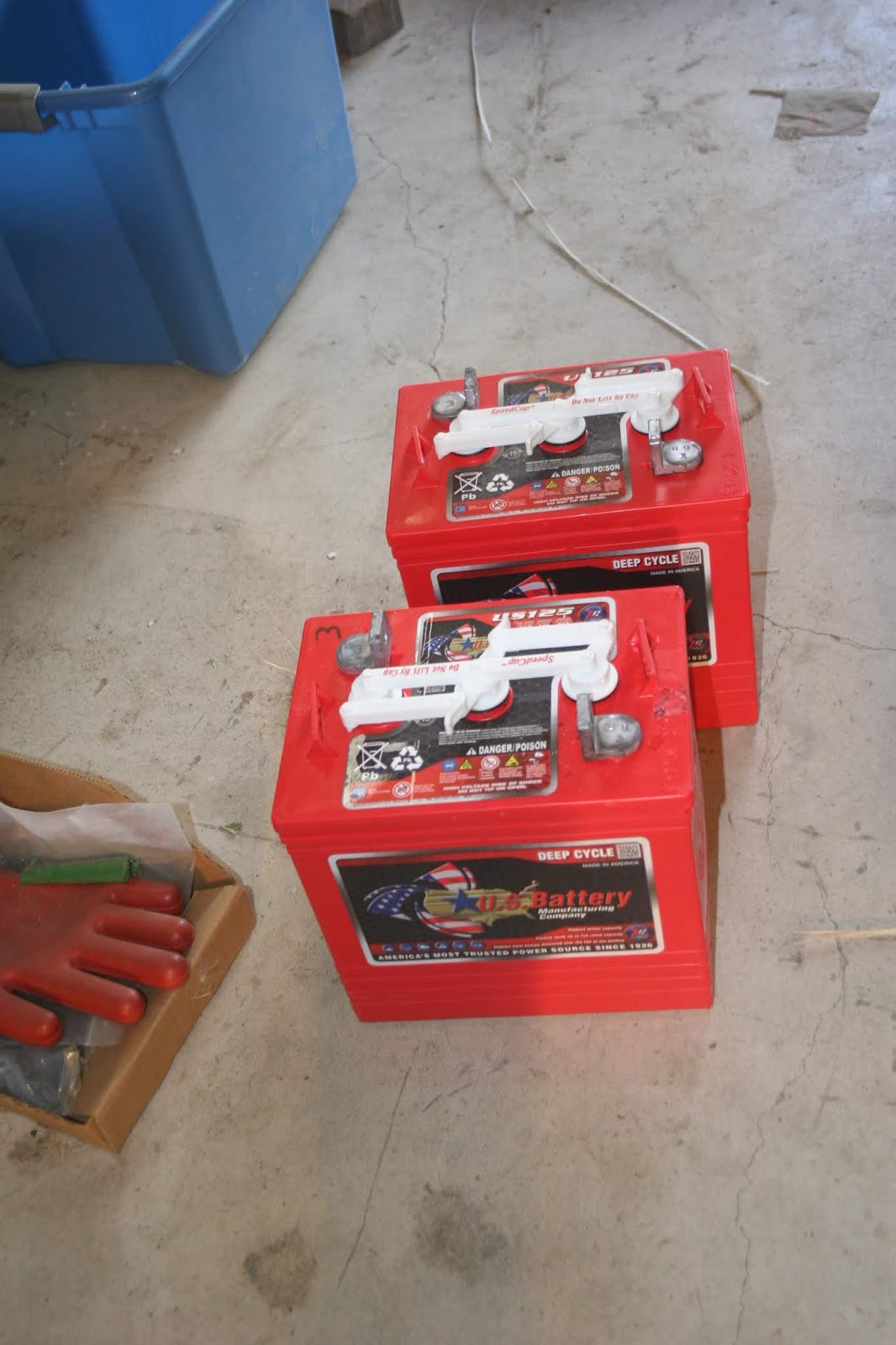 |
| US125 Golf Cart Batteries (Total of 18 in car) |
 |
| "Blackie" the Tech helper. (Stray cat that adopted us about a year ago.) |
 |
Rear Battery Pack Installed
|
Tuesday, December 11, 2018
Ho-Ho-Ho... not so much!
12/11/2018
Snowing today.
VW is sitting exactly as it was in the last post. I hope to get back to the lithium installation in January.
Golf cart fixed:
> Bad controller - installed new Alltrax 400 amp controller.
> Left axle broke and the wheel fell off! Replaced the axle. (Bought from Buggies Unlimited - a highly recommended company.)
> Installed two solar panels on the top of the cart, replacing the plastic top. I used a "boost type" charge controller to charge the 48vdc battery pack. I have been using the cart for running around the ranch for several months and have not had to use any aux. charging.
> Added two LED driving lights. Mounted one on the left front edge of the solar module and one on the right front edge. Works GREAT!
Tuesday, July 31, 2018
No progress on VW
Too many "must do" projects, right now.
- Broken water line to our underground sprinkler system. Lawn looks completely disreputable i.e., looks like hell!
- Electric golf cart suddenly quit last week. I need to troubleshoot it and fix. Getting tired of long walk to the barn/shop and back several times a day.
- Weeds growing like there is no tomorrow. I need to start making that happen.
- Wife and I picked up and hand unloaded 1200 lbs. of chicken feed.
Friday, July 27, 2018
RESURRECTION!

For the last five years my Electric VW Cabriolet has been "lounging" in my barn. Prior to the "internment" I drove it almost 20,000 miles, until the original set of 16 golf-cart batteries finally pooped out. It was my intent to replace the "flooded lead-acid" batteries with Lithium cells. At that time, Lithium was very expensive. I calculated to obtain the same performance, the Lithium battery pack would cost around $12,000. I decided to wait until the cost declined substantially.
Gradually, the cost for Lithium dropped ... but until last years, it was still over $7,000. With the wide acceptance of comsumer electric vehicles, such as the Toyota Prius, the Chevrolet Volt and the Nissan Leaf, there were a certain number of these vehicles that ended up crashed. One vehicle, in particular, the Nissan Leaf, had a Lithium battery pack that was quite adaptable to custom-made electric vehicles. Many were salvaged.

This is a battery pack from a Nissan Leaf that I purchased last week. It consistes of 48 lithium modules, each about 8 vdc, for a total of about 385 vdc. Since my VW's controller has a maximum voltage rating of 144 dvc, I will split the battery pack into three parallel strings of 16 modules, each, for an output voltage of 128 vdc. (My original golf cart battery pack was 96vdc.)
With the original battery pack, my maximum range was about 50 miles and a top speed of 65 mph. With this new lithium pack, I am hoping for about 50% great numbers.
Follow along, from day-to-day, as I upgrade the vehicle.
My hope is to be up and running by mid-August.
Thursday, August 18, 2011

Subscribe to:
Posts (Atom)